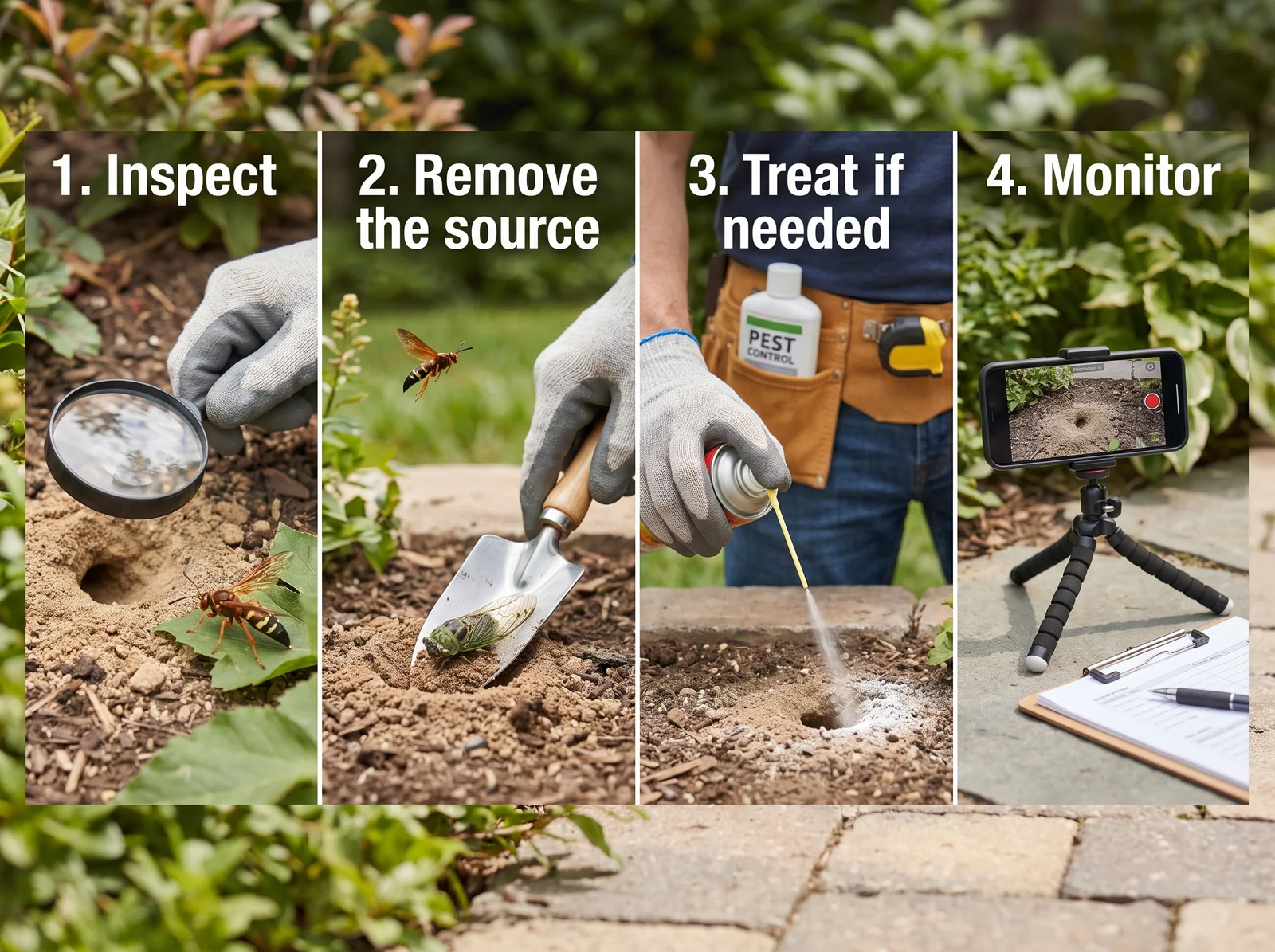
Why are cicada killers nesting in your lawn?
Female cicada killers search for specific ground conditions to dig their underground nurseries. They prefer light, dry, well-drained soil in sunny locations, especially where grass is thin, patchy, or entirely absent.
Flower beds with exposed dirt, sandboxes, areas under playground equipment, and gaps along sidewalk edges are prime real estate. Once a female excavates a burrow, she hunts annual cicadas in nearby trees, paralyzes them, and drags them underground to feed her developing larvae.
How do you identify their burrows?
Cicada killer activity leaves very distinct soil patterns that differ from those of rodents or earthworms. You will see a clean, round hole about the diameter of a nickel or quarter, accompanied by a noticeable U-shaped mound of loose dirt kicked out around the entrance.
Unlike social yellowjackets, each tunnel belongs to an individual female. However, several females often choose the same patch of dry lawn, creating a cluster of individual tunnels that looks like a larger infestation.
How does soil moisture discourage these wasps?
Cicada killers strongly avoid digging in damp or saturated ground because wet dirt easily collapses their tunnels. One of the most effective non-chemical deterrents is simply increasing your lawn watering schedule in areas where you spot digging activity.
Apply water deeply using a sprinkler or soaker hose to keep the top few inches of soil consistently moist throughout mid-to-late summer. When the wasps find the soil too heavy or muddy to excavate, they usually abandon the area to seek drier ground elsewhere.
What landscape changes prevent them from returning?
Long-term management depends on fixing the thin turf that attracted the wasps in the first place. Dense, healthy grass forms a thick root system that physically blocks females from reaching the soil to dig.
Aerate and overseed your lawn in early autumn to establish a thick carpet of grass before the next season. In landscape beds, maintain a three-inch layer of hardwood mulch, gravel, or landscape fabric over bare patches so wasps cannot dig into the underlying soil.
- Raise your lawn mower blade to leave grass at three inches or higher during summer.
- Apply organic fertilizer to encourage dense root growth in bare patches.
- Cover unplanted garden soil with thick mulch or ground cover plants.
How can you physically block active tunnels?
If you have only a few active burrows in a high-traffic area, you can physically exclude the wasps. Wait until evening or early morning when the adult female is either resting deep inside or hunting off-site.
Place heavy landscape pavers, flat stones, or fine wire mesh directly over each burrow entrance. Step down firmly on the surrounding mound to collapse the tunnel entrance. When the wasp returns, she will find the entrance blocked and will move on after attempting to clear the obstruction.
When should you consider chemical controls?
Chemical treatments are rarely necessary because adult cicada killers die naturally by late summer, and their burrows cause minimal structural damage. However, if a nest sits right next to an entryway, deck, or children's play area, spot treatment of individual holes may be warranted.
Avoid broadcasting sprays across your entire lawn, as this harms beneficial pollinators and natural predators. If you choose to treat, use only an EPA-registered product specifically labeled for ground-nesting wasps and outdoor residential turf. Apply the product directly into the active burrow entrance at dusk according to all printed package directions.
How do you handle aggressive males during removal?
When you walk near nesting sites, large wasps may buzz aggressively around your head or dive-bomb toward you. These are male cicada killers defending their mating territory from other insects and intruders.
Male wasps lack a stinger and cannot harm you, despite their loud hovering behavior. If their territorial flights make outdoor chores uncomfortable, you can temporarily deter them by running a lawn sprinkler in the area while you work, which forces them to take shelter.
Questions you may still have
Can cicada killer wasp stings cause serious harm?
Female cicada killers possess a stinger used primarily to paralyze cicadas, and they do not have nest-guarding instincts like hornets or yellowjackets. They will only sting a human if stepped on barefoot, grabbed, or roughly handled. A sting produces mild, localized pain and swelling similar to a minor bee sting, though anyone with severe insect venom allergies should exercise caution.
Will filling a burrow with sand or gravel stop them?
Filling an active hole with loose sand rarely works because female wasps are powerful diggers equipped with specialized spine-bearing legs designed to move soil quickly. They will easily re-excavate the sand within hours. To permanently close an entrance, you must compact heavy topsoil, saturate the area with water, or cover the spot with a rigid barrier like landscape fabric or stone.
How long does a cicada killer infestation usually last?
Adult cicada killer activity is relatively brief, typically lasting only four to six weeks during mid-to-late summer to align with the emergence of annual cicadas. Once females finish laying eggs and provisioning their underground cells with food, the adults die off naturally. The new generation remains underground as pupae through the winter and will not emerge until the following summer.