Why are cicada killers nesting in your laneway?
Laneways and driveways provide ideal real estate for female cicada killers. These solitary insects seek out dry, loose, well-drained soil in sunny locations where digging requires minimal effort. The bare dirt strips between vehicle tracks or the unmaintained sandy edges alongside your lane are prime targets.
Unlike social wasps that build paper nests under eaves or in trees, each female cicada killer excavates her own underground burrow. A single laneway can attract dozens of individual females if the substrate remains dry, powdery, and open to full sun throughout mid-to-late summer.
How do you identify their burrows along a driveway?
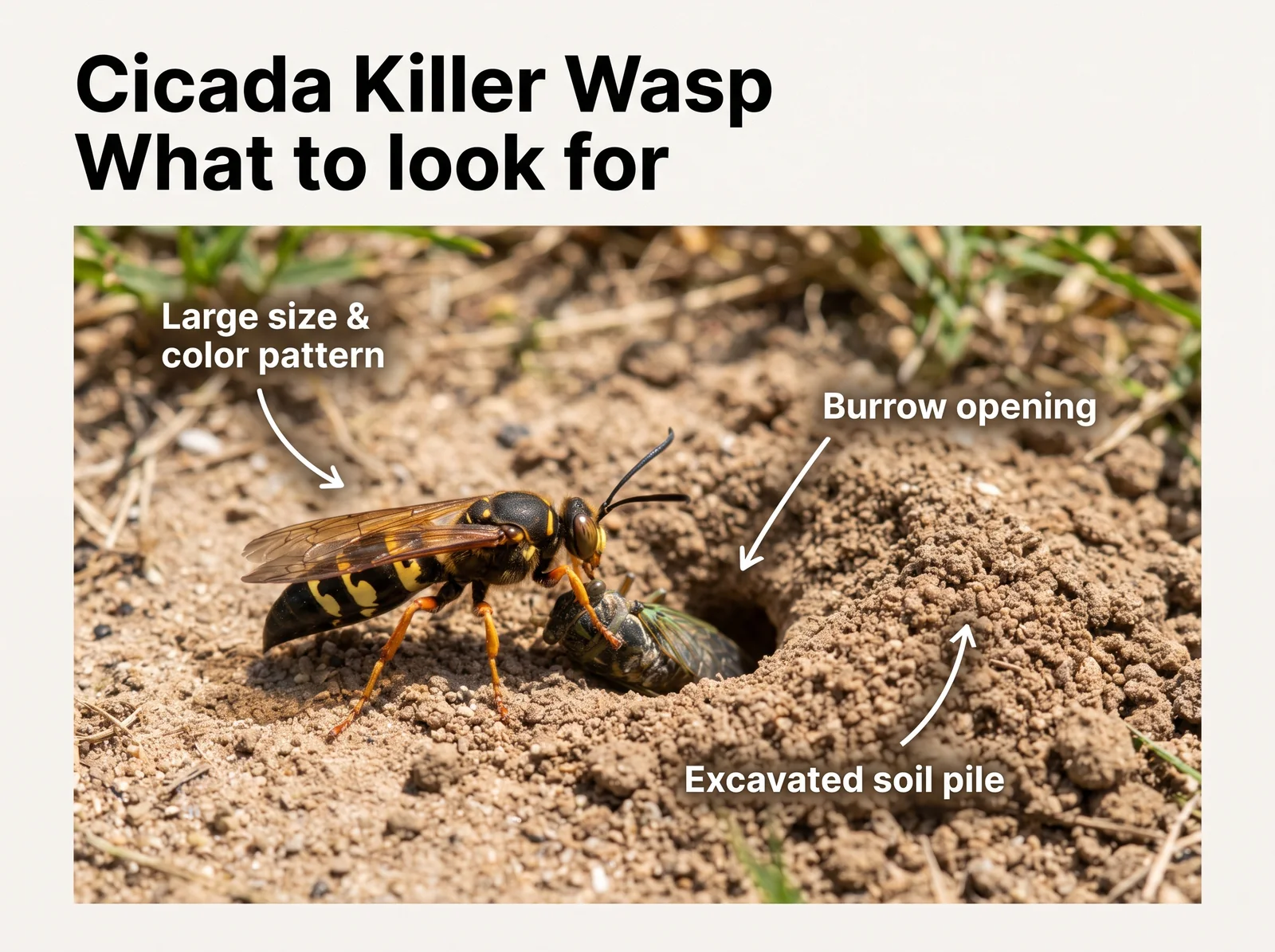
Cicada killer nests look like small dirt mounds with a distinct entrance hole roughly the diameter of a nickel or quarter. As the female digs, she pushes excavated earth out behind her, creating a characteristic U-shaped or fan-shaped pile of loose dirt directly outside the opening.
You will often notice these mounds along unpaved wheel ruts, in cracks between asphalt edges, or within the sand joints of decorative brick pavers. Spotting these excavated piles confirms that wasps are actively establishing nests rather than simply flying through your yard.
Can moisture management deter nesting activity?
Cicada killers strongly avoid digging in wet, heavy, or saturated earth. Applying water to the nesting zone is one of the simplest non-chemical ways to disrupt their digging habits and encourage them to move elsewhere.
If your laneway has dirt edges or unpaved sections, keep those areas consistently moist using a garden hose or sprinkler during peak digging season in July and August. The wet earth collapses easily, clings to the insect, and makes tunnel excavation difficult, prompting the wasps to abandon the site.
How can you modify laneway materials to block burrows?
Physical barriers and ground compaction permanently remove the loose soil that cicada killers need. Loose, fine sand and powdery dirt invite excavation, while tightly packed or covered surfaces prevent it entirely.
Upgrading your laneway surface provides long-term protection against recurring summer infestations. Implementing structural landscape changes creates a permanent barrier that stops burrowing before the seasonal cycle starts.
- Fill dirt margins and vehicle ruts with angular crushed stone or heavy gravel rather than fine sand.
- Apply polymeric sand or joint stabilizing sealer between driveway pavers to harden the gaps.
- Compact loose soil along lane borders with a mechanical tamper or lawn roller.
What landscaping changes help protect lane borders?
Open, bare earth on either side of your laneway serves as an open invitation for digging pests. Establishing thick vegetation creates a dense root network that physically prevents wasps from pushing soil to the surface.
Planting tough turfgrass, low-growing clover, or dense ground cover plants along the perimeter shields the underlying dirt from sunlight and root-binds the soil. Adding a three-inch layer of hardwood bark mulch over exposed borders also discourages wasps, as they cannot easily burrow through coarse organic material.
Should you consider chemical treatments for severe infestations?
Non-chemical habitat changes should always serve as your primary strategy. However, if wasps create extensive burrow networks that undermine pavers or create safety concerns along high-traffic footpaths, targeted treatments may be evaluated.
If you choose to use an insecticide, select an EPA-registered product specifically labeled for ground-nesting wasps and outdoor residential sites. Apply the product strictly according to the complete label directions directly at the individual burrow entrance after dark when the female is resting inside.
How do you maintain your laneway across seasons?
Cicada killer wasps produce only one generation per year, and adults die off naturally by early autumn. However, the larvae remain protected deep inside their underground chambers through the winter and emerge the following summer as new adults.
Use late autumn and spring to perform structural maintenance while the insects are dormant. Grading the driveway, filling low spots with coarse aggregate, fixing washouts, and establishing robust border plants before July ensures emerging wasps find no suitable nesting soil when warm weather returns.
Questions you may still have
Are cicada killer wasps aggressive toward people and vehicles?
Cicada killers are very docile despite their large size. Male wasps patrol territories aggressively and may hover near moving cars or pedestrians, but they lack stingers and cannot harm you. Females possess stingers to paralyze cicadas, but they ignore humans and only sting if stepped on or handled directly.
Can cicada killer burrows cause structural damage to a laneway?
Individual burrows rarely cause major damage, but dozens of tunnels concentrated along paver joints or driveway edges can displace significant soil over time. This soil loss can cause paver stones to shift, loosen edging, or accelerate erosion along unpaved gravel tracks after heavy rains.
Will filling existing burrow holes with dirt solve the problem?
Simply sweeping dirt back into an active burrow rarely works because the female can easily re-excavate the loose soil within minutes. To stop the activity, you must alter the soil condition by saturating it with water, applying coarse gravel, or compacting the surface firmly.