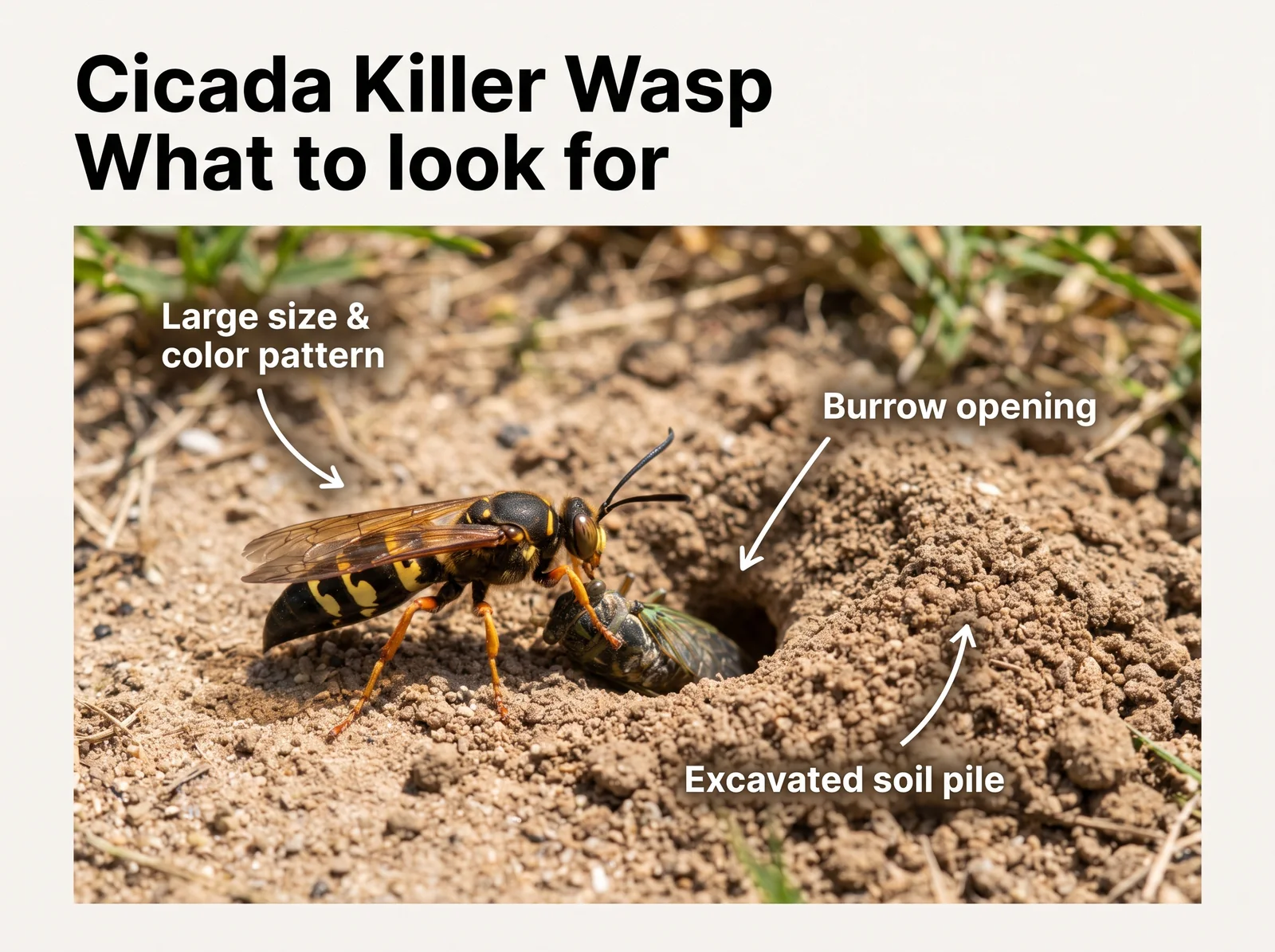
What does a cicada killer wasp burrow look like?
Before you take action, make sure you are dealing with a cicada killer burrow and not a social wasp colony or rodent hole. A typical cicada killer nest features a clean, nickel-sized entrance hole surrounded by a distinct U-shaped or crescent-shaped pile of loose dirt.
Unlike social yellowjackets that share a single entrance with hundreds of aggressive workers, female cicada killers dig individual tunnels. A single tunnel can stretch up to ten inches deep and contain multiple side chambers where the female stores paralyzed cicadas for her offspring.
You will usually spot these burrows along sidewalk edges, in sandy garden beds, under shrubs, or in thin patches of lawn that receive full sun throughout the day.
- Round entrance hole about one-half to three-quarters of an inch wide.
- Loose, dry soil kicked out in a distinct horseshoe pattern.
- Solitary activity with one female entering and leaving per burrow.
Why are cicada killers nesting in your lawn?
Female cicada killers search for very specific nesting habitat. They prefer light, well-drained, sandy soil that is easy to dig through. Dry ground makes excavating fast and keeps the subterranean brood cells stable through mid-summer.
Sunlight and sparse vegetation also play major roles. Lawns with patchy grass, bare soil, and heavy sun exposure warm up quickly, creating the ideal temperature for developing wasp larvae. If your yard provides easy digging and nearby trees host singing cicadas, your lawn becomes prime real estate.
Understanding these preferences helps you fix the root problem. The wasps are not attacking your yard; they simply take advantage of exposed dirt that lacks regular moisture and dense plant roots.
How can you disrupt the nest using water?
One of the simplest, non-toxic ways to discourage nesting is by altering soil moisture. Cicada killers despise wet, muddy ground because it collapses their tunnels and makes digging nearly impossible.
Set up a sprinkler over the active burrow zone and run it for several days during late morning when adult wasps are most active. Soak the soil thoroughly so the top few inches remain damp instead of dry and powdery.
As the ground turns heavy and wet, the female wasp will typically abandon the tunnel project and move away in search of drier, easier soil. Regular watering also helps your turf recover, filling in the gaps that drew the wasps initially.
How do physical barriers help eliminate burrows?
If you only have a few visible burrows in garden beds or along patio borders, physical disruption can convince the wasps to leave. Start by raking down the excavated dirt mound and tamping the soil firmly over the entrance hole.
Covering the problem spot with landscape fabric, heavy mulch, or gravel prevents the wasp from reopening that specific channel. You can also place flat stones or bricks directly over the holes for several days.
Because these wasps work alone, repeated physical disturbance exhausts their energy. When faced with blocked entrances and firm ground, they quickly give up and seek unobstructed digging areas elsewhere.
What long-term lawn changes prevent future nests?
The permanent fix for cicada killer burrows is building a dense, healthy turf. Thick grass with strong root networks forms an impenetrable barrier that keeps solitary digging wasps out of your yard season after season.
Aerate compacted sections, overseed bare patches in late summer or early spring, and apply fertilizer based on your soil needs. Maintain your mowing deck at a height of three to four inches during peak summer heat to shade the ground surface.
In flower beds and landscape islands, maintain a three-inch layer of hardwood mulch. Mulch retains soil moisture and physically blocks wasps from reaching the bare dirt beneath.
- Mow grass high to keep ground cool and shaded.
- Aerate and overseed thin areas each autumn.
- Maintain thick mulch layers across exposed planting beds.
When should you consider chemical treatments?
Chemical treatments are rarely necessary for cicada killers because the insects are non-aggressive and active for only a few weeks each summer. However, if burrows threaten high-traffic entryways, playgrounds, or structural paths, targeted spot treatments can resolve the issue.
Never blanket spray your entire lawn or broadcast chemicals into the air. If you decide to apply a product, select an EPA-registered dust or liquid labeled specifically for ground-nesting wasps and outdoor lawn use. Read and follow all package instructions, safety gear requirements, and re-entry times.
Apply the labeled product directly into the entrance of each active burrow during the late evening or early morning when the female rests inside, then monitor the area for several days to verify activity has stopped.
Questions you may still have
Are cicada killer wasps dangerous to children and pets?
Cicada killers look intimidating due to their large size, but they pose very little danger. Males cannot sting at all, though they may hover protectively near burrows. Females possess a stinger used to paralyze cicadas, but they are solitary and docile. A female will only sting if stepped on, squeezed, or handled roughly.
Will cicada killers return to the exact same spot next year?
Yes, new adults can emerge from underground cocoons the following summer if previous burrows successfully produced larvae. Additionally, wandering females often seek out the same sunny, sandy conditions. Improving your turf density, adding mulch, and keeping the soil moist during mid-summer will stop returning wasps from reusing the site.
Do cicada killer burrows cause lasting damage to lawns?
The damage is almost entirely aesthetic. The wasps do not eat grass roots or kill plants; they merely displace a small handful of soil while excavating. Raking the dirt flat and watering the grass back down typically restores the appearance of your lawn with no permanent root damage.