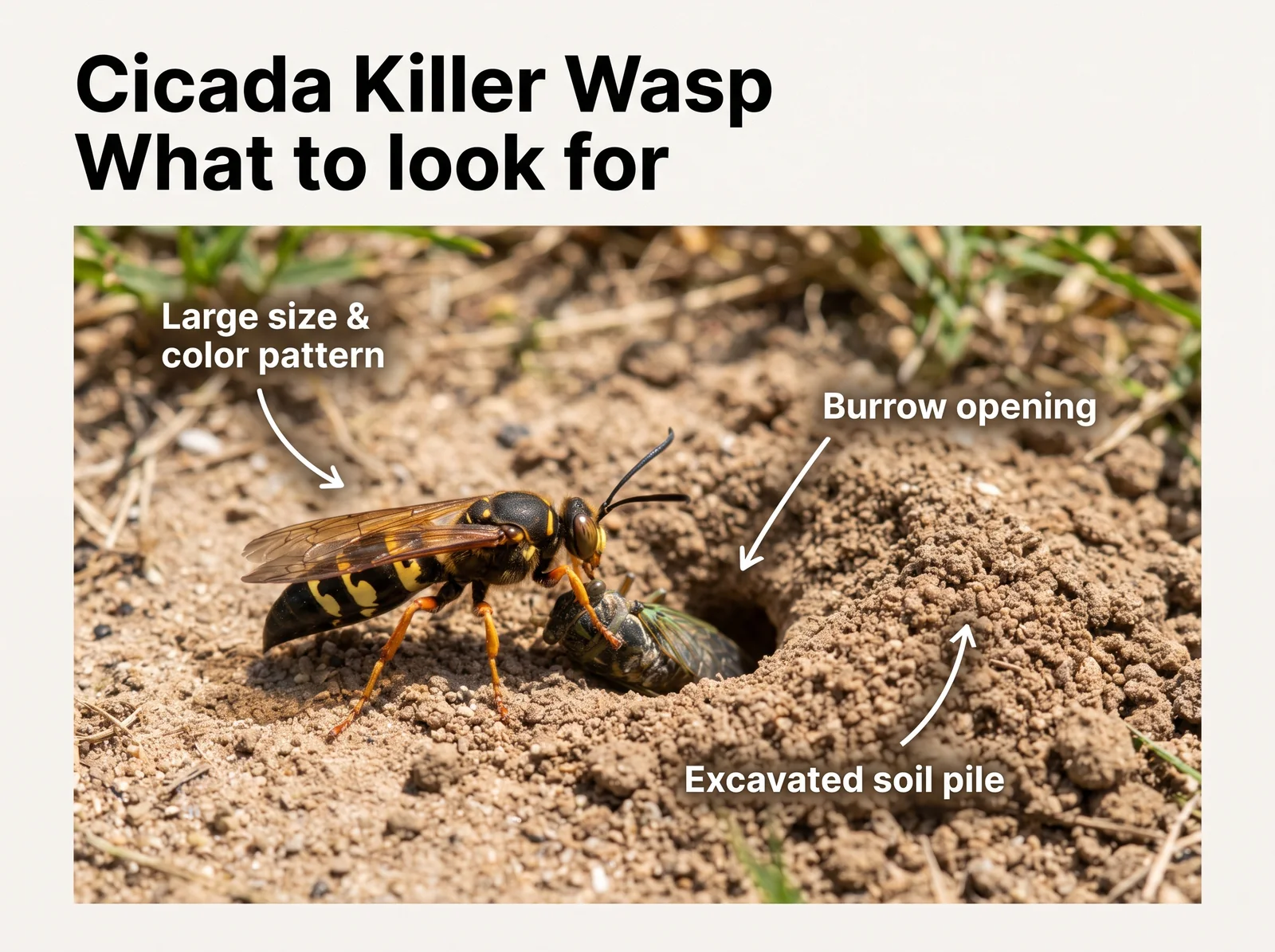
Why are cicada killer wasps digging in your yard?
Cicada killer wasps choose nesting sites based on soil texture, sun exposure, and food availability. Female wasps search for dry, loose, sandy soil in direct sunlight where digging underground tunnels requires minimal effort. Sparse turf, garden edges, and bare patches under shrubs provide the exact conditions they prefer.
Unlike social wasps that build shared paper nests, each female cicada killer excavates her own independent burrow. While several wasps may nest in the same sunny area, they do not cooperate or defend a central colony. They hunt annual cicadas in nearby trees, paralyze them, and drag them into these burrows to feed their larvae.
How do you tell cicada killers apart from other stinging pests?
Before taking action, confirm the species living in your yard. Cicada killers measure up to two inches long, with black bodies, distinct yellow band markings on their abdomens, and reddish-amber wings. Their substantial size often causes people to confuse them with aggressive hornets or yellowjackets.
Their behavior is a key identifier. You will see individual wasps flying low over the grass or kicking dirt out of ground tunnels. Male wasps establish territories and hover near humans to investigate, but they lack stingers entirely. Females have stingers strictly reserved for hunting cicadas and will not sting unless stepped on, grabbed, or directly handled.
Can changing your lawn care routine deter them?
The most effective, long-term way to clear cicada killers is to eliminate the dry, bare soil they rely on for nesting. These wasps avoid dense, moist ground because wet soil collapses their burrows and makes digging difficult.
Adjusting your regular maintenance routine creates an unwelcoming environment that pushes the population elsewhere naturally.
- Water dry patches of lawn deeply and consistently during mid-to-late summer when adults are most active.
- Raise your lawnmower blade to keep turfgrass tall, thick, and shading the soil beneath.
- Aerate and overseed sparse lawn areas in early autumn or spring to fill in bare spots before the next breeding season.
How do you block and disturb active burrow entrances?
Physical exclusion works well if you only have a handful of burrows along walkways, patios, or play areas. Raking down the distinctive U-shaped dirt mounds levels the ground and forces the wasp to spend valuable energy re-excavating the entrance.
Covering active entrance holes with landscape fabric, heavy tarps, or temporary stepping stones prevents the female from returning with paralyzed cicadas. Deprived of easy access to her egg chambers, the wasp will usually abandon the immediate area to dig elsewhere.
Will mulching garden beds stop them from nesting?
Mulch is an outstanding physical barrier in flowerbeds, around tree bases, and along foundation plantings where turf does not grow. Cicada killers struggle to dig through coarse, heavy materials to reach the underlying soil.
Apply a three-to-four-inch layer of hardwood bark mulch, wood chips, or crushed gravel over open garden soil. Ensure the material covers all exposed edges, especially sunny slopes where female wasps prefer to start their tunnels.
When should you consider targeted pesticide treatments?
Non-chemical deterrents solve most infestations, but severe tunneling in high-traffic areas may occasionally require direct treatment. Avoid broad broadcast sprays across the entire yard, as widespread applications harm beneficial pollinators and rarely reach the deep underground chambers where larvae develop.
If chemical intervention is necessary, select only an EPA-registered product explicitly labeled for ground-nesting wasps and outdoor lawn use. Apply the product directly to individual burrow openings according to all package instructions, ideally in late evening or early morning when the female is inside the tunnel.
What is the expected timeline for their activity to end?
Adult cicada killer wasps have a very short active lifespan, typically emerging in mid-July and disappearing by early September. Once the females finish provisioning their burrows with cicadas and laying eggs, the adult population dies off naturally for the season.
The larvae remain dormant underground throughout winter and spring, developing into adults the following summer. Because adults tend to return to the area where they emerged, improving your lawn density during the offseason is the best defense against their return next year.
Questions you may still have
Do male cicada killer wasps present any real danger to pets or children?
Male cicada killers are harmless because they do not have stingers. They often dive-bomb or buzz around people and pets to defend territory, but this behavior is entirely a bluff. Female wasps do possess stingers, but they ignore humans unless roughly handled or accidentally stepped on with bare feet.
Can pouring boiling water down a burrow eliminate the wasp?
Pouring boiling water into a burrow can kill individual wasps or larvae inside, but it is not a recommended long-term solution. Boiling water risks scalding nearby turfgrass and plant roots, leaving dead patches that attract future nesting females. Deep lawn irrigation is safer and more effective.
Do cicada killer wasps cause structural damage to home foundations?
Cicada killers do not damage concrete foundations or underground utility lines. However, heavy nesting under paver patios, stone retaining walls, or sidewalk slabs can occasionally displace enough underlying sand and soil to cause slight settling or uneven surfaces over several seasons.