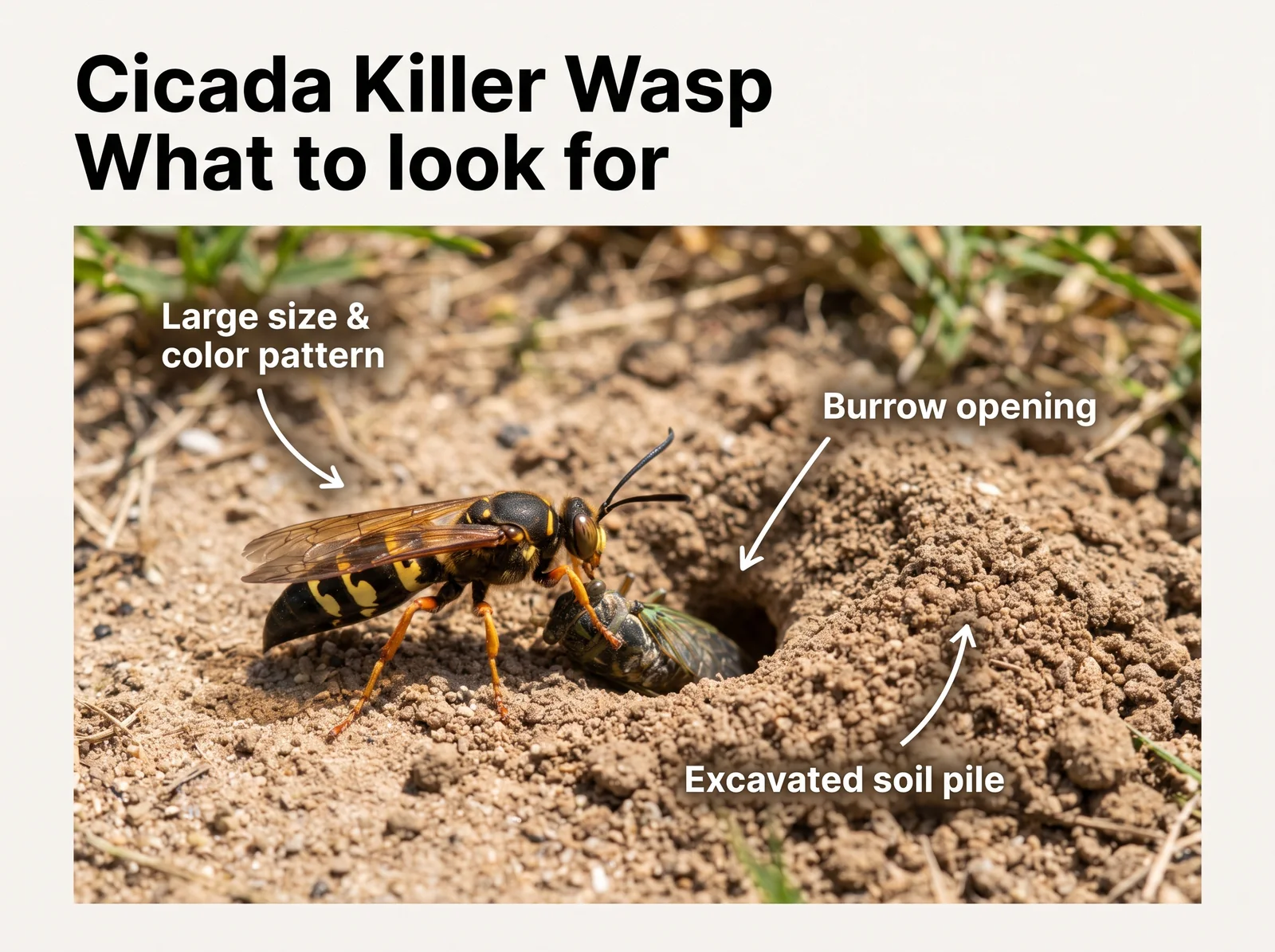
How do you identify a cicada killer wasp nest?
Cicada killer nests look like miniature volcanoes scattered across your lawn, garden beds, or along patio edges. A female digs a tunnel roughly one-half to one inch wide, pushing out a distinctive U-shaped mound of loose dirt around the single entrance hole.
Unlike yellowjackets or honeybees, cicada killers are solitary insects. Each female constructs and provisions her own private burrow. While you might see dozens of holes in the same sunny patch of dirt, each opening represents an independent tunnel rather than a shared colony.
- A single entrance hole about the diameter of a nickel or quarter.
- A fresh pile of excavated dirt shaped like a horseshoe around the opening.
- Locations in dry, sandy, or poorly vegetated soil exposed to direct sunlight.
Why are cicada killers nesting in your yard?
Female cicada killers search for specific environmental conditions before they begin digging. They prefer loose, well-drained, sandy soil that receives plenty of sunlight throughout the day. Thin turf, sparse garden beds, and gravel pathways offer easy digging conditions.
Your yard also needs a nearby population of annual cicadas in mature trees. The female hunts cicadas, paralyzes them with a sting, and drags them back to her burrow to feed her larvae. If your property provides both easy digging and nearby prey, it becomes prime real estate.
Are these ground nests dangerous to your family?
Cicada killer nests rarely present a physical danger to people or pets. The intimidating wasps you see buzzing aggressively near the ground are almost always males. Male wasps lack a stinger entirely and defend territory purely through bluffing and dive-bombing.
Female wasps possess a stinger used primarily to subdue cicadas. Females are non-aggressive and will not defend their nests if you walk nearby. A sting only happens if you step on a female barefoot or grab one accidentally. For most yards, nest damage is purely aesthetic.
How can water help eliminate active burrows?
Water is one of the simplest non-chemical tools to disrupt cicada killer nesting. Because these insects require dry, warm soil to dig stable tunnels, wet soil quickly discourages them. Saturated ground causes tunnel walls to collapse and slows down their digging speed.
Apply water heavily to the nesting area using a garden hose or sprinkler system. Keep the soil consistently moist for several days during peak digging season in mid-summer. The females will usually abandon muddy, wet soil and search for drier ground elsewhere.
What physical methods deter nesting in bare soil?
You can physically block wasps from using established holes by modifying the ground surface. Rake flat any dirt mounds you find in the early morning or late evening. Once the dirt is level, cover open bare patches with landscape fabric, dense mulch, or temporary tarps.
Placing physical barriers over active burrow zones forces the wasps to expend extra energy looking for new sites. In garden beds, adding a three-inch layer of hardwood mulch stops digging, as the wasps struggle to move heavy, coarse wood chips away from the dirt.
When and how should you apply chemical treatments?
If cultural methods fail and nesting creates an unacceptable nuisance, targeted chemical treatment can resolve persistent burrows. Always select an EPA-registered insecticidal dust or spray labeled specifically for ground-nesting wasps and outdoor lawn use.
Apply the product directly into individual burrow openings late in the evening or before sunrise when the female is resting inside. Avoid broadcast spraying across your entire lawn. Follow all container instructions regarding protective equipment, application steps, and keeping pets off treated grass.
How do you prevent cicada killers from returning next year?
Long-term prevention requires fixing the turf conditions that attracted the wasps in the first place. Because cicada killer larvae overwinter underground and emerge the following summer, improving your lawn density in autumn and spring prevents future generations from settling.
Aerate, overseed, and fertilize bare or thin lawn sections to create a thick root system that wasps cannot dig through easily. Raise your lawn mower blade to keep grass taller, which shades the soil surface and keeps the ground cooler and less attractive to nesting females.
Questions you may still have
Can I simply step on or fill in the burrow holes to trap the wasps?
Stepping on or packing dirt into the burrow entrance usually does not work. Female cicada killers are powerful diggers equipped with strong legs and mandibles. They can easily dig their way out of collapsed tunnels within a few hours, or they will quickly excavate a new exit hole right next to the original site.
How long does a cicada killer nesting cycle last?
Active nesting lasts roughly four to six weeks during mid-to-late summer, coinciding with annual cicada activity. Once females finish digging, provisioning cells with paralyzed cicadas, and laying eggs, their natural life cycle ends. Adult wasps die off naturally by late summer, leaving the sealed larvae to develop underground until the next year.
Will cicada killer wasps damage the structure of my patio or foundation?
Cicada killers can displace significant amounts of loose sand or gravel from beneath pavers, flagstones, and sidewalk slabs. While they do not chew through stone or concrete, extensive tunneling beneath poorly supported hardscaping can cause uneven settling or sunken bricks if multiple wasps nest along the same paver joints over several seasons.