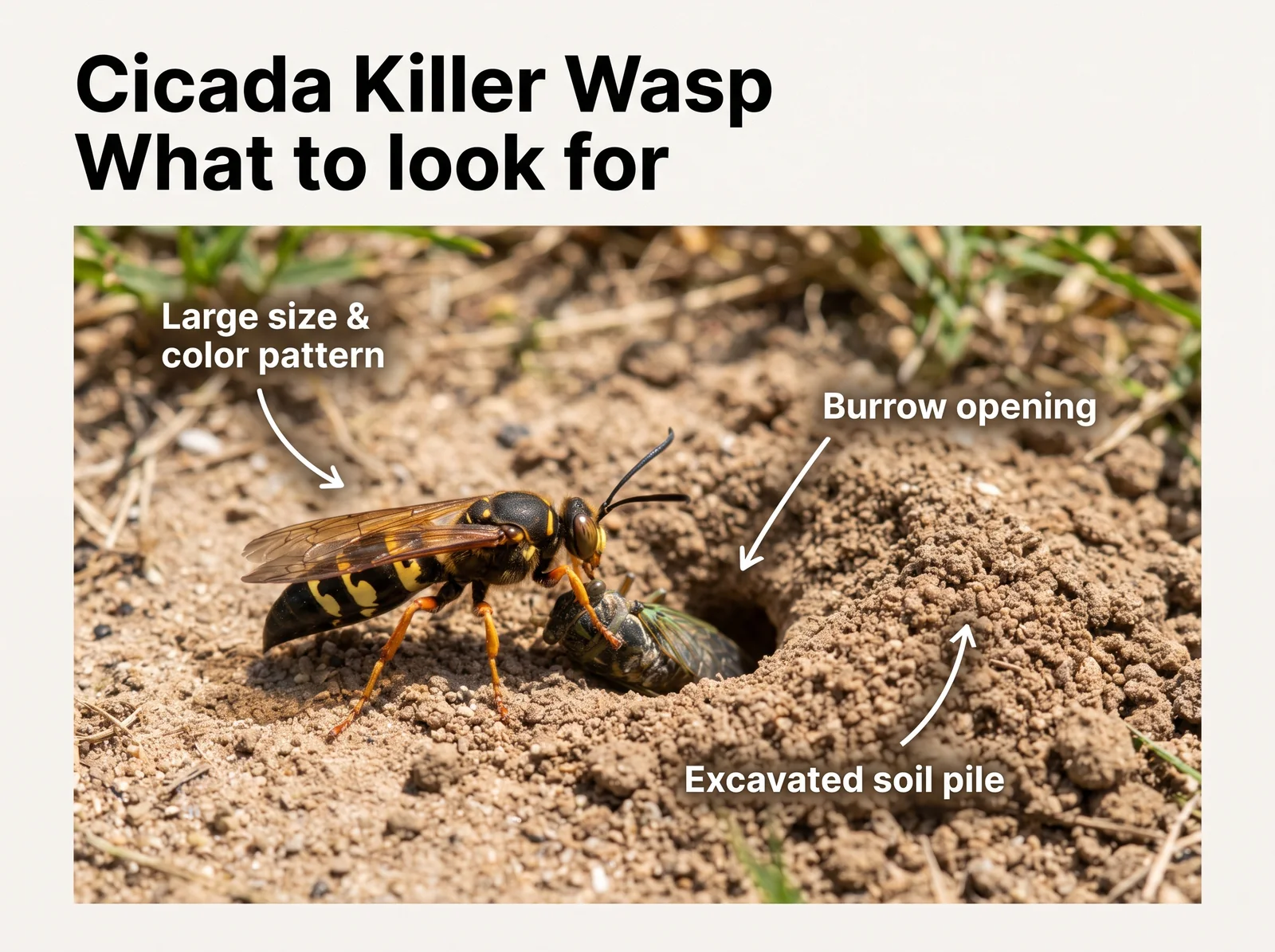
Why are giant cicada killer wasps digging in your yard?
Cicada killers target yards that offer easy digging conditions. Female wasps look for loose, sandy, or dry soil exposed to direct sunlight. You will commonly find their characteristic horseshoe-shaped dirt mounds along sidewalk edges, retaining walls, flower beds, and thinning turf.
Each female works alone to dig a nursery burrow for her offspring. She paralyzes annual cicadas in nearby trees, drags them down into her underground chambers, and lays an egg on each one. If your property has ample cicada activity and patchy grass, it serves as prime nesting real estate.
- Unshaded areas with sparse, patchy grass.
- Dry, well-draining sandy loam or garden mulch.
- Proximity to deciduous trees housing loud annual cicadas.
Are cicada killers dangerous to people and pets?
Despite their intimidating size of up to two inches long, cicada killers are not aggressive toward humans or family pets. They lack the colony-guarding instincts found in social hornets or yellowjackets.
The wasps you see dive-bombing or hovering near your knees are almost always males. Male cicada killers are territorial and put on a showy bluff, but they lack a stinger entirely. Females possess stingers to paralyze cicadas, but they only sting people if stepped on barefoot, grabbed, or squeezed.
How can lawn care naturally deter cicada killers?
The most sustainable way to eliminate cicada killer activity is improving your lawn density. These wasps hate pushing through thick, dense turf and wet soil to excavate tunnels.
Apply grass seed and fertilizer to thin or bare spots in late summer or early spring. Water your turf consistently during peak burrowing season in July and August. Moist soil discourages females from starting new tunnels and can cause existing open burrows to collapse naturally.
Mow your grass at a higher setting during the summer months. Taller grass blades cast shade over the soil surface, cooling the ground and making it far less attractive to sun-loving nesting females.
Can physical disruption push nesting wasps away?
Physical disruption can persuade females to abandon their burrows before they finish stocking them with prey. Because they invest substantial energy into digging, constant disturbances often force them to seek quieter territory.
Use a garden rake to flatten the piles of excavated soil around each hole daily. Running a sprinkler over the nesting zone for several days creates damp conditions that make digging nearly impossible for the wasp.
For small landscape beds, consider laying down landscape fabric topped with a dense layer of coarse bark or heavy gravel. This creates a sturdy physical barrier that stops females from reaching the soil below.
Do traps and decoys work for cicada killer wasps?
Standard commercial wasp traps designed for yellowjackets will not work on cicada killers. Social wasps are drawn to sweet liquids and protein baits, whereas cicada killers feed exclusively on flower nectar and hunt live cicadas for their larvae.
You can catch individual problem wasps using a standard insect net during the heat of the day when they are most active near their burrows. While catching individual insects takes patience, it helps reduce small, localized populations without introducing chemicals to your garden beds.
When should you apply targeted control methods?
If a high concentration of burrows creates tripping hazards along a walkway or playground area, targeted burrow treatments may be considered. Always treat burrows individually at dusk or dawn when the female rests inside.
If using a pesticide, select only an EPA-registered product specifically labeled for ground-nesting wasps and outdoor lawn use. Apply the product directly into the entrance of the individual burrow according to the container directions, rather than broadcasting chemicals across your entire lawn.
How do you prevent cicada killers from returning next summer?
Cicada killers tend to return to the same patches of land year after year if conditions remain unchanged. Larvae overwinter in the soil and emerge as adults the following summer.
Break this annual cycle by repairing your soil structure in early spring before adult emergence. Aerate compacted soil, topdress with compost, and overseed thin turf. Establishing thick, healthy ground cover ensures that when the next generation emerges, your lawn will no longer offer the dry, open ground they need to dig new burrows.
Questions you may still have
How long do adult cicada killer wasps stay active each year?
Adult cicada killers are typically active for only six to eight weeks in mid-to-late summer. Their emergence coincides directly with the arrival of annual cicadas. Once females finish digging burrows and laying eggs, the adult population dies off naturally as autumn approaches.
Will cicada killer wasps ruin my lawn structure?
They cause minor cosmetic damage rather than structural destruction. Each burrow produces a small pile of excavated soil around the entrance hole. While these piles can look messy on a manicured lawn, the tunneling activity does not damage root systems and actually provides minor soil aeration.
Are cicada killers the same insect as the Asian giant hornet?
No. Cicada killers are native, solitary North American wasps. Asian giant hornets are a completely different social species with distinct yellow-orange heads, darker striping, and highly defensive group behaviors. Cicada killers have black abdomens with pale yellow bands and reddish, translucent wings.